AI now writes ad copy, builds reports, and suggests keywords in seconds. As a result, many marketers wonder whether their jobs will survive. The good news is that the marketing skills AI can’t replace still exist, and you can learn them. In this guide, you will discover seven of these skills. You will also see how to build each one step by step.
This article is written for early-to-mid-career marketers in SEO, content, social media, and paid ads. However, students and freelancers will find it useful too. Our goal is simple: to help you master the marketing skills AI can’t replace. Let’s start with the big picture.
Why AI Is Changing Marketing, Not Ending It
AI is very good at speed. For example, it drafts a blog outline in seconds and summarizes a campaign report in minutes. However, speed is not the same as judgment. AI works from patterns in past data, so it struggles with new situations.
Moreover, AI has no stake in your business. It does not feel pressure from a client, and it cannot sit across from a customer. Therefore, tasks that rely on human context stay with people. Meanwhile, repetitive tasks move to machines. In short, human skills in digital marketing still decide who wins.
Because of this shift, the smart move is to grow the skills that AI lacks. Think of it as a career upgrade rather than a threat. Let’s look at the skills now.
The 7 Human Marketing Skills AI Can’t Replace
Each of these marketing skills AI can’t replace follows the same pattern. First, you will see why AI falls short. Next, you will read a short real-world scenario. Finally, you will get practical steps to build the skill. Use these future-proof marketing skills as a personal upskilling checklist.
1. Strategic Thinking and Brand Strategy
Strategy means choosing what not to do. It connects business goals, budget, and market timing into one clear plan. Strategic thinking is one of the marketing skills AI can’t replace, because someone must own the trade-offs.
- Why AI falls short: AI does not know your company’s cash flow, internal politics, or long-term ambitions. As a result, its advice often sounds sensible but fits no one in particular.
- Real-world scenario: A small skincare brand has a limited budget. AI suggests ten channels. A strategist picks only two, because the brand’s buyers rely on reviews and email. That choice saves money and wins loyal customers.
- How to build it: First, study the business model behind every campaign you run. Next, write a one-page strategy before each project starts. Finally, review the results and note which choices worked.
- Career payoff: Marketers who think strategically move into leadership roles faster. Companies pay for decisions, not just tasks.
2. Original Research and First-Hand Insight
Original research is another of the marketing skills AI can’t replace. Search engines and readers both reward fresh information. AI can only remix what already exists online. Google also encourages people-first content that shows real experience. Therefore, original findings give your work a clear edge.
- Why AI falls short: AI cannot run a survey, interview a customer, or test a landing page with real visitors. It repeats existing knowledge instead of creating new knowledge.
- Real-world scenario: A B2B marketer interviews five clients about why they chose her company. They all mention fast support, not low price. She rewrites the homepage around that theme, and demo requests rise.
- How to build it: Start small. Run a short poll on social media or send a three-question survey to customers. In addition, document your A/B tests and publish the results. Over time, you will own data that nobody else has.
- Career payoff: Original data earns backlinks and press mentions. It also makes your portfolio memorable.
3. Empathy and Deep Audience Understanding
Empathy is among the marketing skills AI can’t replace, because great marketing makes people feel understood. Empathy lets you sense the frustration, hope, and hesitation behind a click. AI can analyze sentiment. Still, it cannot truly feel what a customer feels.
- Why AI falls short: Data shows what people do. Empathy explains why they do it. AI often misses the emotion behind a purchase, especially in sensitive moments such as healthcare or finance.
- Real-world scenario: A fitness app notices that users quit in week two. A marketer calls ten of them. Many feel embarrassed about missing workouts. A kinder reminder message then cuts drop-offs.
- How to build it: Talk to real customers every month. Read support tickets and reviews, not only dashboards. Also, practise writing each message for one person rather than a crowd.
- Career payoff: Empathetic marketers write copy that converts, which makes them valuable to any employer.
4. Critical Judgment and Editing AI Output
AI produces confident answers, even when they are wrong. Someone must decide what is accurate, on-brand, and worth publishing. That someone is you. Even Google’s guidance on AI-generated content puts quality ahead of how content is produced.
- Why AI falls short: AI can invent facts, miss the right tone, or repeat clichés. Furthermore, it cannot tell when a good-looking draft will hurt the brand.
- Real-world scenario: An AI tool writes a product page that promises guaranteed results. A careful editor spots the legal risk and fixes the claim before launch.
- How to build it: Fact-check every statistic before you use it. Create a brand voice checklist and apply it to each AI draft. In addition, practise rewriting AI text until it sounds like a real person wrote it.
- Career payoff: Teams trust people who catch errors early. That trust leads to bigger projects.
5. Relationship Building and Negotiation
Relationships are also marketing skills AI can’t replace. Marketing runs on trust. Clients, partners, and influencers work with people they like and respect. A chatbot can send emails, yet it cannot build a long-term partnership.
- Why AI falls short: Negotiation requires reading the room, adjusting on the fly, and knowing when to stay silent. These soft signals never appear in a text prompt.
- Real-world scenario: A freelancer wants to raise her rates. Instead of sending a price list, she meets her client and shares the results she delivered. Together they agree on a new retainer. The relationship makes the difference.
- How to build it: Attend industry meetups and join online communities. Follow up with people after every call. Moreover, practise negotiation by role-playing with a colleague.
- Career payoff: Strong relationships bring referrals, repeat clients, and job offers that never reach a job board.
6. Original Creative Direction and Taste
Creativity is more than producing content. It involves taste, which means knowing what feels fresh and what feels stale. AI generates plenty of ideas. However, it tends toward the average, because it learns from what already exists.
- Why AI falls short: A bold campaign often breaks a pattern. AI predicts the most likely next step, so it rarely takes real creative risks.
- Real-world scenario: A local coffee shop wants more attention. Instead of generic social posts, its marketer hosts a book-swap day where customers trade novels over coffee. The idea feels human, and it spreads fast.
- How to build it: Collect campaigns you admire and write down why they work. In addition, set aside time each week for brainstorming without any tools. Then use AI to expand your best ideas, not to start them.
- Career payoff: A distinct creative taste is hard to copy, so it supports higher pay.
7. Ethics and Accountability
Marketers make choices that affect real people. Privacy, honesty, and inclusion all demand human responsibility. When a campaign goes wrong, a person must answer for it.
- Why AI falls short: AI has no conscience and no accountability. It can produce biased or misleading content without noticing.
- Real-world scenario: A targeting tool suggests aiming a loan ad at financially stressed users. A responsible marketer rejects the idea because it exploits vulnerability. That decision protects the brand’s reputation.
- How to build it: Learn the basics of data privacy rules in your region. Next, add an ethics check to your campaign review process. Finally, speak up when a tactic feels wrong, even under deadline pressure.
- Career payoff: Ethical marketers protect brands from costly mistakes, and employers reward that protection.
How to Work With AI Instead of Against It
Knowing the marketing skills AI can’t replace is only half the plan. You also need to use AI well. Think of it as a fast but inexperienced assistant. It works hard, but it needs clear direction.
- Let AI handle first drafts, data cleanup, and keyword grouping.
- Keep strategy, final edits, and client conversations for yourself.
- Learn prompt writing, because clear instructions give better results.
- Track new tools monthly, but master a few instead of chasing every launch.
As a result, you spend less time on routine work. Moreover, you gain more time for the skills that raise your value.
A Simple 30-Day Plan
In week one, audit your tasks and mark which ones AI can do. In week two, pick one human skill from the list above. In week three, practise it on a real project. Finally, in week four, review what you learned and set your next goal.
This plan is small, but it works. Consistent practice beats a big burst of effort. Besides, real projects give you proof of skill for your portfolio.
Which Skill Should You Build First?
You do not need to master all seven skills at once. The skills marketers need in the age of AI depend on your current role. Instead, choose based on where you work today. For instance, content writers should start with original research and judgment. Meanwhile, paid ads specialists gain the most from strategy and ethics.
If you work with clients, begin with relationship building. If you work in a large team, start with critical judgment. In both cases, pick the skill that solves your biggest daily problem. That choice keeps your motivation high.
Common Mistakes When Upskilling for the AI Era
Many marketers make the same errors when they try to future-proof their careers. Avoiding them saves months of wasted effort.
- Ignoring AI completely. Refusing to learn the tools puts you behind your peers.
- Relying on AI for everything. Blind trust leads to errors and bland content.
- Collecting certificates without practice. Real projects teach more than another course.
- Waiting for the perfect moment. Because AI keeps changing, the best time to start is now.
Conclusion: Build the Skills That Last
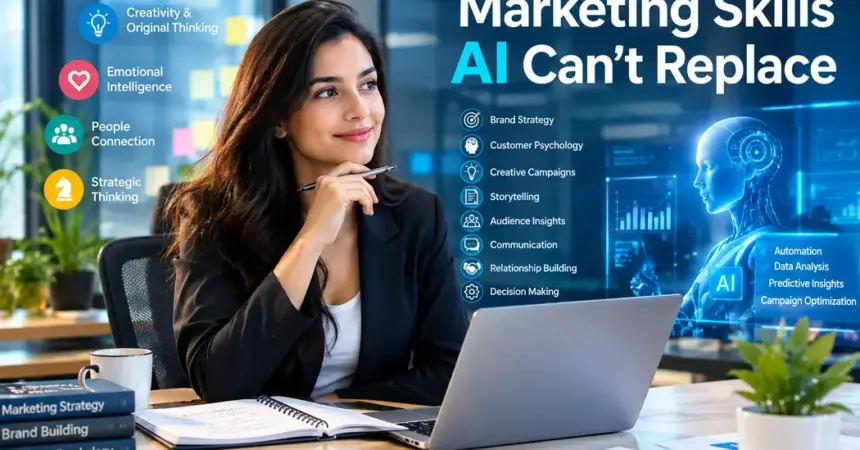
AI is a powerful tool, but it is not a replacement for human insight. The marketing skills AI can’t replace include strategy, original research, empathy, judgment, relationships, creativity, and ethics. Together, these skills make you valuable in any market, no matter how fast AI improves.
So, pick one skill today and start practising. Small steps add up quickly. Which skill will you build first? Share your answer in the comments, and subscribe for more career-focused marketing guides.
FAQs
Will AI replace marketers?
AI will replace some tasks, but not the whole profession. Marketers who use AI well will likely outperform those who ignore it. Therefore, adapting matters more than worrying.
Which marketing jobs are safest from AI?
AI-proof marketing careers are built on strategy, relationships, and creative leadership. Examples include brand strategists, marketing managers, and customer insights leads. However, every role will change, so keep learning.
How can beginners build these skills?
Start with small real projects, such as a personal blog or a volunteer campaign. In addition, ask for feedback often. Practice with real audiences teaches faster than courses alone.
Is digital marketing still a good career?
Yes, it remains a strong path for people who keep learning. Companies still need professionals who can think, connect, and decide. Hence, focus on skills that machines lack.
Which AI tools should marketers learn first?
Start with a general assistant such as ChatGPT or Gemini for drafting and brainstorming. In addition, learn Google Analytics for reporting. However, tools change quickly, so focus on how to guide them rather than on one product.