
Wondering how to start a business with AI when you have no technical background and a small budget? You’re in good company. AI tools now handle work that once needed a whole team, including writing, design, bookkeeping, and customer support. As a result, starting an AI business costs far less than it did a few years ago. However, tools alone don’t create a business. Customers do.
This guide gives you a practical, step-by-step path. You’ll go from spotting a real problem to winning your first paying client. Along the way, you’ll see where AI helps most and where it can mislead you. There are no get-rich-quick promises here, only steps you can act on this week.
Quick summary
- The opportunity: AI in business is widespread, but many companies still struggle to use it well.
- The path: here is how to start a business with AI in seven steps: pick a problem, validate demand, choose a model, select tools, build, launch, and improve.
- The smart start: begin with a service or digital product, not a complex AI company.
- The rule: keep a human check on every AI output before a customer sees it.
Why AI in Business Is a Big Opportunity for New Founders
Artificial intelligence for business has moved from experiment to everyday tool. McKinsey’s global survey found that 88% of organizations use AI in at least one business function, up from 78% a year earlier. Yet only about one-third have started scaling it across the whole enterprise. In other words, AI in companies is common, but well-run AI is still rare.
That gap creates openings for small, focused businesses. Here is what it means for you:
- Demand is real. Many companies want to implement artificial intelligence but lack the time, skills, or confidence to do it.
- Setup is the bottleneck. Firms often buy tools, then stall on workflows, training, and quality checks. You can help with exactly that.
- Costs are lower. One person with the right tools can now deliver work that once needed a small team.
Adoption is also spreading among ordinary users. Stanford’s 2026 AI Index reports that generative AI reached 53% of the global population in just three years. More people understand AI, so explaining your offer gets easier. That is why now is a good time to learn how to start a business with AI.
Here are common gaps where AI in companies stalls, and where you could help:
- Automating appointment reminders and follow-up emails for local clinics
- Writing and updating product descriptions for online stores
- Sorting invoices and receipts for freelancers and small firms
- Drafting first replies for customer support teams
AI Company or AI-Powered Business: Which Path Should You Choose?
People use the phrase starting an AI business in two different ways. Some mean building new AI software or models. Others mean running a normal business that uses AI tools to work faster. The second path is far easier for beginners.
| Path | What you do | Skills needed | Best for |
|---|---|---|---|
| AI-powered service | Deliver done-for-you work, such as content, reporting, or workflow setup, using AI tools | Domain knowledge, communication | Beginners who want the fastest start |
| Digital products | Sell templates, guides, or prompt packs built with AI help | Subject expertise, simple design | People with a niche audience |
| AI software or tool (an AI company) | Build and maintain your own AI-based app or model | Technical skills or a technical co-founder | Founders ready for longer timelines and more funding |
If you want to know how to start an AI company that builds its own product, expect more time, technical hiring, and funding. For most beginners, a smarter plan is to start with a service or digital product. Then, once you have paying customers and clear feedback, you can move toward software.
How to Start a Business with AI in 7 Steps
Each step below is small enough to finish in a week or two. Follow them in order, because each one reduces the risk of the next.
Step 1: Choose a Problem and a Niche
The first move in how to start a business with AI is choosing a problem, not a tool. Most beginners start with a tool and hunt for a use, and that order usually fails. Start with a problem that people already pay to solve. Good places to look include:
- Your own work history and the tasks you know well
- Complaints you hear from friends, clients, or colleagues
- Repetitive jobs where people lose time or money every week
Then narrow your focus. “AI for marketing” is far too broad, while “AI-written email newsletters for dental clinics” is specific. AI for small business is a strong starting point, because owners are busy, budgets are tight, and many tasks repeat. Finally, test every idea with these three questions:
- Do you understand the problem well?
- Do customers already spend money on it?
- Can AI make the solution faster or cheaper?
If an idea fails one test, set it aside and try another.
Step 2: Validate Your Idea Before You Start Your AI Business
Validation means checking demand before you spend money. The U.S. Small Business Administration explains how to carry out market research and competitive analysis, including how to study rivals and spot your window of opportunity. Proving demand is key to starting an AI business safely. Use this checklist:
- Search the problem online. Read forums, reviews, and social posts, and note the exact words people use.
- Interview five potential customers. Ask how they handle the task now, what it costs, and what they have tried.
- Study three competitors. List their prices, promises, and weak points.
- Test interest cheaply. Share a one-page offer with ten people. If nobody replies, change the offer, not the tool.
AI can speed up this stage. For instance, you can ask an assistant to summarize competitor reviews or draft interview questions. Still, verify its answers, because AI sometimes states wrong facts with confidence.
Step 3: Choose Your Business Model
Pick one model from the table above and commit to it for your first three months. Services are the fastest to launch because you don’t need to build a product. Digital products come second. Software takes the longest, so save it for later. Whichever you pick, you now have a concrete plan with a defined offer and a price.
Step 4: Pick Your AI Tools
Tool choice is the part of how to start a business with AI that beginners overthink. Keep your toolkit small, because most beginners need only four types of tools:
| Need | What it does | Example tools |
|---|---|---|
| AI assistant | Writing, research, planning, and drafting | ChatGPT, Claude, Gemini |
| Design | Visuals, social posts, and simple branding | Canva |
| Automation | Connects forms, email, and spreadsheets | Zapier, Make |
| Website and payments | Lets customers find you, book, and pay | WordPress, Wix, Shopify, Stripe |
These are examples, not endorsements. Features and prices change often, so check current plans before you commit. When you compare options, look at three things:
- Price: free plans are fine for testing.
- Data privacy: read the terms before you upload any client data.
- Switching cost: make sure you can export your work and move later.
Step 5: Build a Simple First Version
Aim for a minimum viable offer, not a perfect product. Follow this sequence:
- Define one result. For example, “a clean, categorized expense sheet by the 5th of each month.”
- Map the workflow. Write down each task, then mark which ones AI can draft or automate.
- Test on one client. Deliver the result to a friendly first customer.
- Review everything yourself. AI drafts quickly, but you are responsible for accuracy.
- Document the process. Those notes become your repeatable workflow, which is what lets you scale.
If you plan software, start with a no-code builder before you hire developers.
Step 6: Launch and Find Your First Customers
Launching is where how to start a business with AI turns into real customer feedback. Launch small and talk to people directly. These channels work well for new founders:
- Your network: tell people what you do and who it helps.
- LinkedIn and niche forums: post short before-and-after examples where your customers already spend time.
- Local groups: offer a short talk or demo for small business owners.
- Pilot offers: give your first three to five clients a low price in exchange for feedback and a testimonial.
Also, set up a simple page that explains your service, shows your pricing, and lets people contact you. Reuse the words customers used in your interviews, because that language matches what people actually search for.
Step 7: Measure, Improve and Implement Artificial Intelligence in Your Own Operations
Once you have clients, track what works. Note which channel brings the most replies, how long each job takes, and what customers praise or complain about. Then implement artificial intelligence inside your own business too:
- Draft proposals and follow-up emails faster
- Summarize client calls into action lists
- Create reports from your tracking sheet
Each saved hour lets you serve more clients without lowering quality.
7 AI Business Ideas You Can Start Small
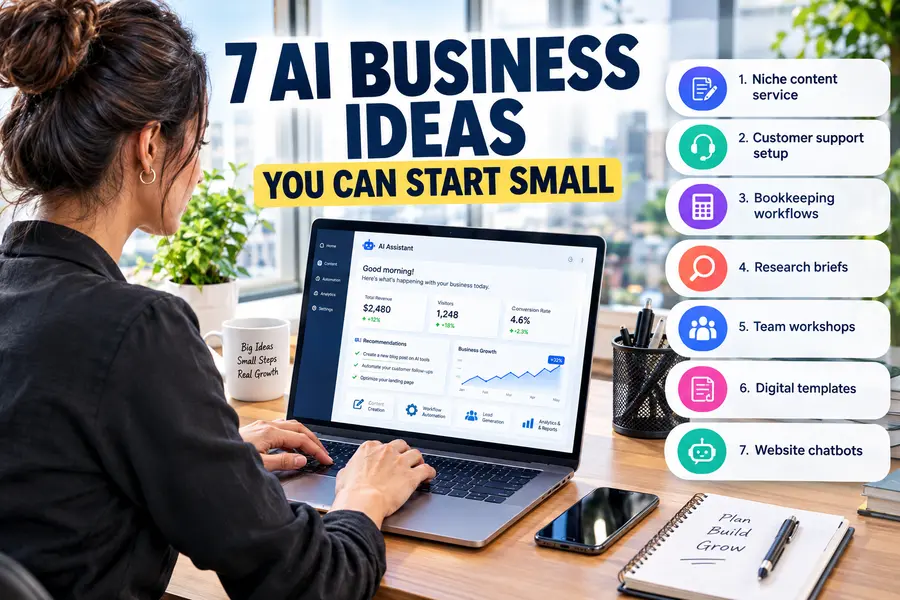
Need inspiration? These ideas fit the service and digital product models, and none requires coding. Many double as AI for small business services.
- Niche content service: newsletters or blog posts for one industry, such as dentists or accountants.
- Customer support setup: AI-drafted reply systems for small online shops.
- Bookkeeping workflows: receipt and invoice sorting for freelancers.
- Research briefs: short, human-checked market summaries for busy owners.
- Team workshops: practical AI training sessions for local businesses.
- Digital templates: prompt packs, planners, or checklists for a specific job role.
- Website chatbots: simple question-and-answer bots built with no-code tools.
A Quick Example: AI Receipt Sorting for Freelancers
Here is a hypothetical example to make the steps concrete. Imagine a bookkeeper named Maria who works with freelance designers. She notices that her clients hate sorting receipts at tax time. That is her problem.
- Validation: After five short conversations, she confirms clients would pay for a faster monthly process.
- Workflow: An AI assistant reads and labels receipts, an automation tool moves them into a spreadsheet, and Maria reviews every entry.
- Launch: She offers the service to three clients at a pilot price and asks for feedback.
Notice what she did not do. She didn’t build an app or promise to replace accountants. Instead, she solved one narrow problem and kept a human in the loop.
How to Keep Costs and Risks Under Control
- Cost: many tools charge monthly fees. Review subscriptions every month and cancel what you don’t use.
- Accuracy: AI can invent facts, numbers, and sources. Check everything that reaches a customer.
- Legal and privacy: rules on data, copyright, and advertising claims differ by country. Check the requirements where you and your customers live, and consider asking a local professional.
- Dependence: if your whole business relies on one tool, a price change or outage can hurt. Document your process so you can switch.
- Expectations: McKinsey’s survey shows many organizations have yet to see measurable financial impact from AI. Promise clients practical gains, not miracles.
Starting an AI Business: Pre-Launch Checklist
Before you announce your offer, confirm each item below:
- You can describe your service and customer in one sentence
- Five or more people confirmed the problem is real
- Your price and payment method are clear
- At least one real client has tried your workflow
- Every AI output gets your review before it reaches a customer
- Local rules on data, taxes, and registration are clear to you
Common Mistakes When You Start a Business with AI
Most people who learn how to start a business with AI make the same few errors. Watch for these:
- Chasing trends: a trending tool is not a customer problem.
- Skipping validation: building first and asking later wastes weeks.
- Publishing unchecked output: AI drafts can contain errors.
- Competing on price alone: cheap work attracts demanding clients. Compete on speed, quality, and focus.
- Doing too much at once: one niche and one offer are enough at the start.
Final Thoughts on How to Start a Business with AI
Starting a business with AI comes down to one simple habit: start with a real problem, then use the right tools to solve it. As AI adoption in business continues to grow, more owners will need practical support, creating opportunities for new, focused companies. Therefore, you can start with a few simple steps:
- Write down three problems you understand well.
- Talk to one person who has each of them this week.
- Pick the strongest problem and start Step 2.
FAQs
Do I need coding skills to start a business with AI?
No. Many service and digital product businesses need no code. No-code tools cover websites, automation, and simple apps. Coding helps if you build software, but you can hire for that skill later.
How to start an AI company without technical skills?
It is harder. Building your own AI product usually needs technical skills or a technical co-founder. A service-based business is a better first step, and it can grow into a product later.
How much money do I need?
It depends on your model. A service business can begin with a few tools on free or low-cost plans, plus a domain name. Software costs more. Set a small test budget, and spend it only after you validate demand.
Is the market too crowded?
Demand for artificial intelligence for business keeps growing, and competition also exists. However, narrow niches and reliable service can still help you stand out. Meanwhile, many companies are still working out how to use AI effectively. Therefore, by focusing on a specific audience, you can build trust faster than a generic competitor.