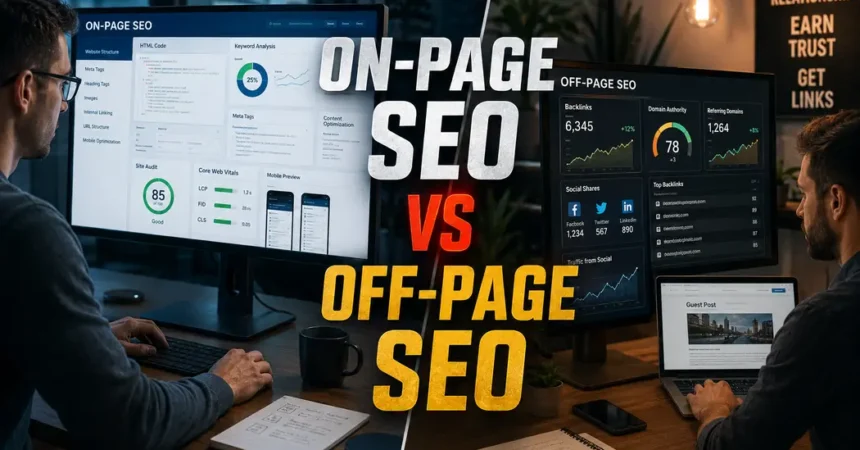
Organic traffic and brand recognition are key factors that help a website achieve high rankings in search engines, driven by digital marketing and SEO. That’s why it is important to understand SEO.
In search engine optimization, on-page and off-page strategies are gold. While they individually address a unique optimization challenge, they are all essential components of a comprehensive SEO approach.
Understanding their relationships will assist you in developing a successful approach that enhances both their visibility and their reputation.
We will investigate On-Page and Off-Page SEO, which includes their definitions and their effects on your website and the factors that actually determine rankings in this competitive industry.
What is On-Page SEO?
All strategies utilized on the website to ensure that it appears in the search engine results page are referred to as SEO. It could also prove helpful in estimating that page’s ranking.
On-page SEO uses both technical and content factors to improve the quality of a page; thus, the more you do, the more relevant and traffic your site will get.
Here are the major factors of on-page SEO:
1. Meta Tags
Meta tags, commonly referred to as snippets of information, are employed to describe what is on a page. The elements exist solely in the page’s source code, and they do not appear on the actual webpage. Title tags and meta descriptions function as the fundamental components of search engine optimization because they provide essential elements for website optimization.
2. Title Tag
On the search engine result page, this is the main text that needs to show up. To get more traffic, keep it short and include the main keyword.
3. Meta Description
The language that shows how the page is located in different layers in the hierarchy of websites.
4. Content Optimization
One of the most important aspects of on-page search engine optimization is the production of content that is both high-quality and relevant.
This entails the following:
5. Keyword Research
Getting the proper keywords and naturally incorporating them into your writing. It is very important to use keywords in different parts of the content, like the title and the header.
6. Content Quality
Providing readers with valuable, engaging, and helpful articles. Texts, graphics, and video may enhance user experience.
7. Internal Linking
Internal linking is the process of linking to other pages within your website. This approach increases page load time by dispersing link equity across your domain. It makes it easier for visitors to navigate your website, keeping them on your site longer.
If you use internal links, search engines will be better able to figure out your site’s structure and context, which will finally lead to better tracking and ranking.
8. Page Load Speed
In terms of both technical search engine optimization and user experience, site load speed is the most important factor. Lower bounce rates and higher engagement rates are often associated with sites that load more quickly.
Get a better position in search engine rankings. Google PageSpeed Insights and other related tools may help in identifying and fixing issues that result in sluggish website loading times.
9. Mobile-Friendliness
The mobile friendliness of a site indicates how well it works on a phone or computer. People can still access essential sections of mobile-optimized websites because these sites automatically adjust their size to match different devices.
The system operates through a single thread, which boosts user experience by providing faster browsing speeds.
What is Off-Page SEO?
Off-page SEO can increase the overall popularity of a site, which can enhance the search engine results page (SERP) generated first due to exposure to on-page SEO.
All of this occurs as a consequence of certain ranking variables that capitalize on opportunities distinct from your website but ultimately lead back to it. Compared to on-page SEO, you have less control over performance; nevertheless, this does not mean that off-page SEO is any less important.
Let’s delve into the essential components of off-page SEO:
1. Backlinks and Link Building
Backlinks are hyperlinks from other websites that link to your site. These are an important ranking factor that provides a “vote of confidence” from one website to another. The process of obtaining these connections is called link building.
Here’s why they matter:
Quality Over Quantity
Search engines give preference to high-quality backlinks instead of counting them. Links from high-authority websites (those with elevated domain authority) provide more value.
Natural Links
Producing high-quality content that others want to connect to should be the natural way to get backlinks. Penalties may result from purchasing links or using link farms.
3. Anchor Text
Optimization for search engines is also affected by the anchor text of a backlink. The most effective anchor text is descriptive and contains a lot of keywords.
4. Social Media Signals
Without directly affecting your SEO, social media may have an indirect effect. Even while search engines don’t directly use social signals to determine rankings, several off-page SEO strategies may benefit from social media:
- Content Distribution: The more people see your content and link to it, the more backlinks you’ll get.
- Engagement: The website can achieve better traffic results and higher authority status through obtaining multiple social media interactions, which include likes, shares, and comments.
- Brand Awareness: The greater the brand’s activity on social media, the greater the chances of its being mentioned or searched for.
2. Brand Mentions
Even if there is no direct hyperlink to your website, brand mentions on the internet might have a good impact on your search engine optimization. Referring to a brand is a sort of credibility that is recognized by search engines. When your brand is referenced may be tracked with the use of tools such as Google Alerts.
3. Influencer Outreach
When you work together with influential people, your search engine optimization efforts might be amplified. An increase in traffic and backlinks of high quality might be the consequence of influential people promoting your material. By establishing trust and authority via their evaluations and mentions, they may encourage additional organic links to be generated from other sources.
4. Domain Authority and Search Rankings Impact
Off-page search engine optimization has a substantial impact on the domain authority of your website, which is a measurement of the organization’s credibility and significance. Having a higher domain authority is often associated with having better search ranks.
On-Page SEO vs Off-Page SEO: Key Differences
1. Focus and Scope
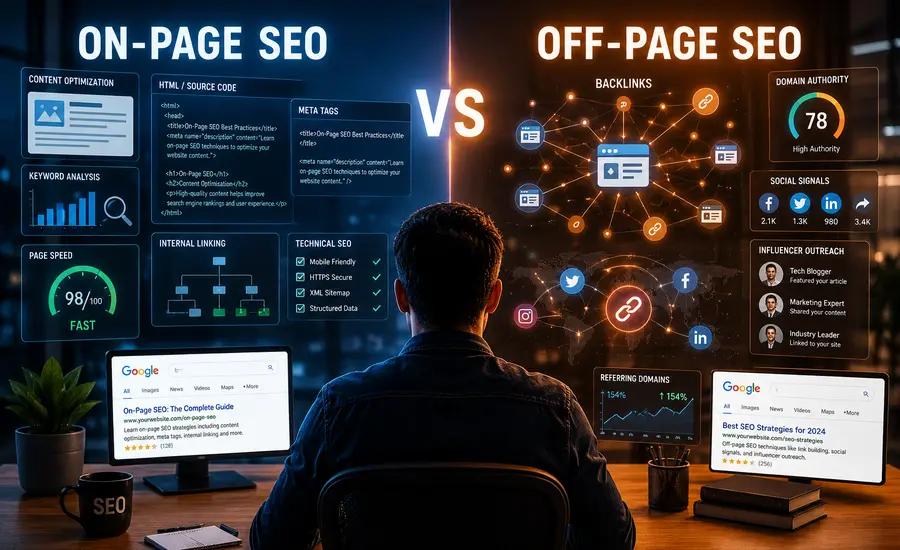
Optimization of content, the proper use of meta tags, internal linking, and quick page loading time come under this. Improving technical SEO factors like usability and design of a website, and optimizing your website for mobile, comes under on-site SEO.
Contrarily, off-page SEO is an activity performed away from your website that dictates your search engine results page (SERP) positions. These are usually link building, gaining backlinks from authoritative sites, utilizing social media signals, and doing influencer outreach.
2. Impact
There are several ways in which on-page and off-page SEO may influence your rankings, such as determining what you rank based on on-page SEO and how high you rank by using off-page SEO.
Search engines need on-page optimization to understand what your content means. Without good on-page basics, search engines don’t deal very well with categorizing your content.
Off-page factors, such as backlinks, show your site’s authority. Google ranks websites with better reputations higher, even when on-page optimization matches. External validation gives you an edge over competitors.
3. Short-Term vs. Long-Term Efforts
Generally, the implementation of on-page SEO changes will deliver faster results for your work. Your website user experience will improve, together with its search engine ranking, when you increase page loading speed and optimize your meta tags.
In contrast, the advantages of off-page SEO work take time to show their complete results. Social media platforms and backlinks need time to develop their full potential. The implementation of off-page SEO will bring both domain authority improvements and extended visibility benefits to your website.
4. Control and Implementation
The amount of control you have over on-page SEO compared to off-page SEO is one of the main contrasts between the two. When you use on-page SEO, you have full authority over the optimization process. For instance, editing your content, updating your meta tags, and optimizing your internal linking structure all happen here. As a result, these changes you make can immediately improve site speed and user experience.
However, you have less influence on off-page SEO, which involves establishing relationships and acquiring links from elsewhere. These are often things that can require a longer-term strategy and regular effort, such as acquiring high-quality backlinks and social mentions.
5. User Experience and Authority
On-page SEO aims to improve the user experience. For example, a better user experience is gained when your website is fast, mobile-friendly, and has high-quality content.
On the other hand, building authority via external validation is what off-page SEO is all about. Your pages’ “PageRank” will increase in proportion to the quality of the backlinks pointing to them. By going through this procedure, your site becomes more reliable.
Overall, the importance of initial impressions is significant to both methods. In contrast, users want fast-loading, user-friendly websites, whereas Google seeks credible sources.
6. Control and Implementation
Your control makes the biggest difference. On-page SEO gives you complete control over your content, keywords, and website structure. As a result, you can change your site directly and see results right away.
In contrast, off-page SEO works differently because most factors lie outside your direct control. You depend on others to link to your content or mention your brand. This makes the process more about building relationships than making direct changes.
Picture on-page SEO as decorating your house’s interior – you choose everything. Off-page SEO works more like your reputation in the neighborhood – it depends on what others say about you.
Final Thoughts
A strong SEO plan requires both on-page SEO and off-page SEO to be implemented together. After all, your vehicle needs both wheels and an engine because both components function as essential parts that drive your vehicle to its destination.
The most effective SEO results occur after websites establish strong on-page optimization. Only then should websites invest their resources in link-building and social media marketing.