
The MacBook Pro touchscreen is finally real. On October 28, 2026, Apple announced the first Mac laptop that responds to touch. The new MacBook Pro also replaces its mini-LED panel with a tandem OLED display that Apple calls PROLED XDR. Pre-orders are open now, and deliveries begin on November 6.
This guide explains what is new, what it costs, and who should consider it.
What happened at the Apple event
Apple first teased the launch on October 19 with an invitation to a “Pro and Tell” experience in Los Angeles. On October 28, Apple announced the new MacBook Pro in an official press release on Apple Newsroom. Attendees at the Apple Pro and Tell event then got hands-on time with the laptops. Apple CEO John Ternus also shared a first look on X.
Bloomberg’s Mark Gurman had predicted the date days earlier. The launch confirmed most of the leaks. However, the rumored “MacBook Ultra” name did not appear. The product is called MacBook Pro.
How the MacBook Pro touchscreen works
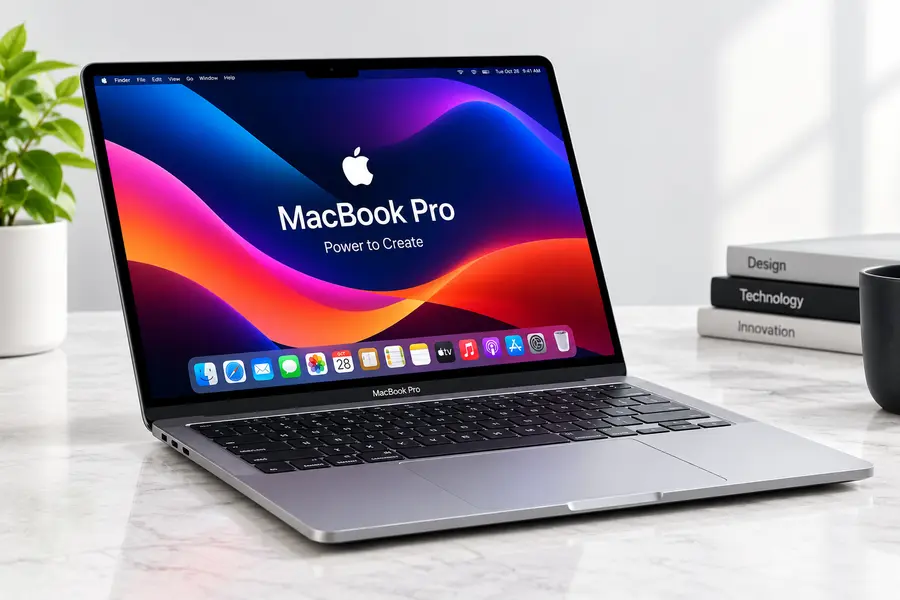
Apple says the touch sensor sits inside the display panel. It is not layered on top. That design should reduce lag and make the screen feel more direct.
You can scroll with a swipe, pinch to zoom, and drag items between apps. You can also double-tap a window to fill the screen. Touch does not replace the keyboard or trackpad. Apple says all three inputs work together.
Existing Mac apps also work with touch from day one, because macOS turns taps into clicks. Developers also get new gesture tools. Apple lists Notion, Canva, Zoom, Microsoft Office, Lightroom, DaVinci Resolve and Blender among the apps adding touch support. Apple says those apps arrive later this year.
The MacBook touch screen mainly targets creative work. Designers can draw across the whole display. Musicians can play instruments on screen. Developers can test iPhone and iPad apps without leaving the Mac.
PROLED XDR display: what tandem OLED brings
Tandem OLED stacks two light-emitting layers. Apple says this produces brighter highlights and deeper blacks than its older mini-LED screens. It also says the panel avoids the glow around bright objects that LCD backlights can cause.
Here are Apple’s headline display figures:
- Peak brightness reaches 2000 nits for HDR and SDR content.
- The contrast ratio is 10,000,000:1.
- The refresh rate adapts between 10Hz and 120Hz.
- The color range covers P3 and Adobe RGB.
All of these numbers come from Apple. Independent reviewers have not tested them yet.
M5 Pro and M5 Max performance
This new MacBook keeps the same chips as the current non-OLED models, according to 9to5Mac’s launch report. You can choose the M5 Pro or step up to the M5 Max. Memory reaches 128GB, and storage reaches 16TB.
Each GPU core includes a Neural Accelerator for AI work. Apple says the M5 Max can run very large language models directly on the laptop. That matters to developers who want private, offline AI tools.
Design, battery and ports
The new Apple MacBook Pro is thinner and lighter than before. The 14-inch model weighs about 3 pounds. The 16-inch model weighs about 4 pounds, which is 0.7 pounds less than its predecessor. Apple credits the slimmer OLED display for much of the saving.
Apple also lists up to 24 hours of battery life. That figure comes from Apple’s own testing, so real-world results will vary. The laptop includes three Thunderbolt 5 ports, HDMI, an SD card slot, MagSafe, and a headphone jack. Also, a Dynamic Island now sits at the top of the screen. It handles Spotlight, live updates, and Siri AI.
MacBook Pro touchscreen price and release date
Apple USA pricing starts at $2,899 for the 14-inch model with M5 Pro. Education buyers pay less. Apple says laptops reach customers and stores on Friday, November 6. Pre-orders are open in 30 countries and regions, including the United States.
| Model | Starting price (U.S.) |
|---|---|
| 14-inch, M5 Pro | $2,899 |
| 16-inch, M5 Pro | $3,399 |
| 14-inch, M5 Max | $4,499 |
| 16-inch, M5 Max | $4,799 |
Prices outside the U.S. may differ, so check Apple’s local store before you order.
New MacBook Pro vs. the non-OLED model
Apple will keep selling the mini-LED version, according to Tom’s Guide’s live coverage of the launch. Performance looks similar because both use M5 Pro and M5 Max chips. By comparison, 9to5Mac notes that the OLED model adds the touch display, a light-up Apple logo, and a thinner, lighter body.
If you edit photos or video, the new display may justify the extra cost. If you mostly type and browse, the older model still looks strong.
What about the MacBook Pro M6?
Many readers ask about a MacBook Pro M6. The touchscreen model does not use that chip. It runs on the M5 Pro or M5 Max.
However, Apple did launch a separate 14-inch MacBook Pro with the M6 chip on October 27. That MacBook M6 arrived one day earlier, along with an M6 iMac. It is a different product from the touchscreen model, so compare both before you buy any new MacBook Pro.
Who should buy the new MacBook Pro?
The new MacBook Pro suits creators who draw, grade color, or make music. It also helps developers who build for iPhone and iPad. Everyone else can reasonably wait for independent reviews. Early adopters should also remember that Siri AI is still in beta.
Final thoughts
This new MacBook Pro marks a real shift for the Mac. A touch display, a tandem OLED panel, and a lighter body arrive together. Still, Apple makes the biggest claims. Wait for independent reviews before you spend $2,899 or more.
FAQs
Does the new MacBook Pro have a touchscreen?
Yes. It is the first Mac laptop with touch input built into the display.
When can I buy it?
Pre-orders began on October 28. Deliveries and store sales start on November 6.
Does the touchscreen MacBook Pro use the M6 chip?
No. It uses the M5 Pro or M5 Max—a separate 14-inch model with the M6 chip launched on October 27.
Is the old MacBook Pro discontinued?
Not according to Tom’s Guide. The mini-LED version stays on sale.


